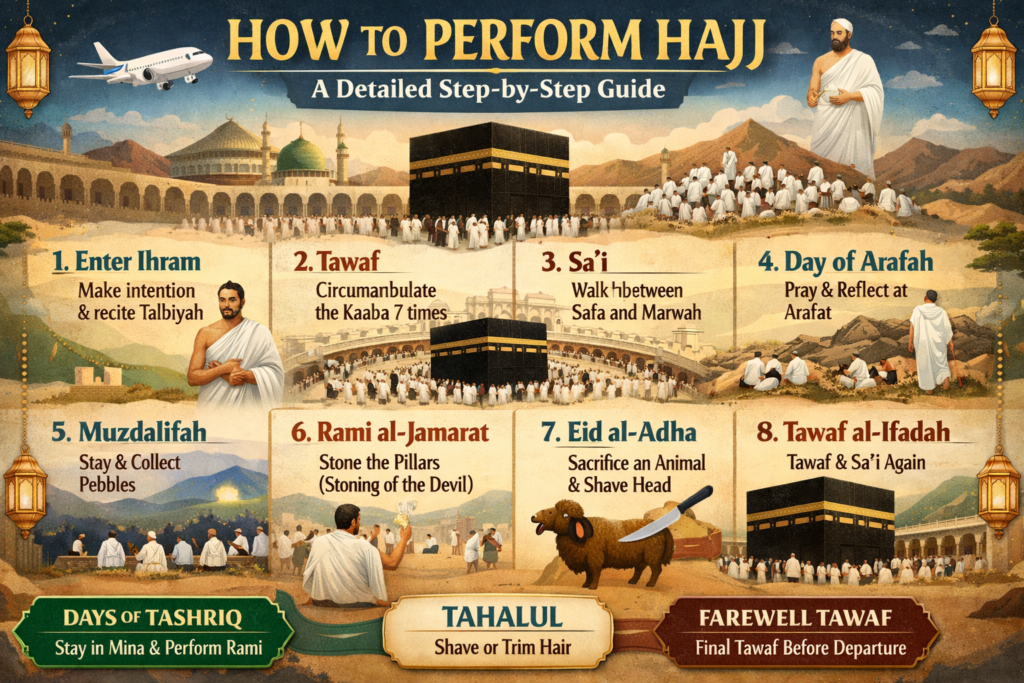
How to Perform Hajj: A Detailed Step-by-Step Guide
Hajj Ka Mukammal Tariqa – Duaon Ke Sath Tafseeli Rehnumai
Hajj Islam ke paanch bunyadi arkaan mein se ek azeem ibadat hai jo har sahib-e-istitaat Musalman par farz hai. Yeh sirf ek safar nahi balkay ek roohani inqilab hai jo insan ki zindagi ko badal deta hai. Har saal lakhon Musalman duniya bhar se Makkah Mukarramah ka rukh karte hain aur aik hi libas (Ihram) mein Allah ke samne kharay hote hain, jo barabri aur ittehad ki behtareen misaal hai.
Is tafseeli guide mein hum Hajj ke tamam marahil ko Roman Urdu mein samjhayenge aur har aham muqam par parhi jane wali duain bhi Arabic aur Urdu tarjuma ke sath bayan karenge.
Hajj Se Pehle Tayari
Hajj se pehle roohani aur jismani dono tayyari zaroori hoti hai. Sab se pehle apni niyyat ko khalis karein aur Allah se apne gunahon ki maafi talab karein. Apne rishtedaron aur doston se maafi maangna bhi sunnat hai.
Aap ko chahiye ke:
- Hajj ke arkaan seekhein
- Zaroori saman tayar karein
- Ihram ka libas khareedein
- Quran Pak saath rakhein
Step 1: Ihram aur Niyyat
Jab aap Meeqat par pohanchain, to Ihram bandhna hota hai.
Niyyat aur Talbiyah:
Arabic:
لَبَّيْكَ اللَّهُمَّ لَبَّيْكَ، لَبَّيْكَ لَا شَرِيكَ لَكَ لَبَّيْكَ، إِنَّ الْحَمْدَ وَالنِّعْمَةَ لَكَ وَالْمُلْكَ، لَا شَرِيكَ لَكَ
Urdu Tarjuma:
“Main hazir hoon ae Allah! Main hazir hoon, tera koi shareek nahi, main hazir hoon. Beshak tamam tareef aur ne’matein teri hi hain aur badshahat bhi, tera koi shareek nahi.”
Ihram ke baad insan par kuch pabandiyan lag jati hain jo usey gunahon se bachati hain.
Step 2: Tawaf-e-Kaaba
Makkah pohanch kar sab se pehla amal Tawaf hota hai.
Tawaf Ki Dua:
Arabic:
رَبَّنَا آتِنَا فِي الدُّنْيَا حَسَنَةً وَفِي الآخِرَةِ حَسَنَةً وَقِنَا عَذَابَ النَّارِ
Urdu Tarjuma:
“Ae hamare Rab! Humein duniya mein bhi bhalaai ata farma aur aakhirat mein bhi bhalaai de aur humein dozakh ke azaab se bacha.”
Tawaf ke duran jitna ho sake zikr aur Quran ki tilawat karni chahiye.
Step 3: Safa aur Marwah Ki Sa’i
Tawaf ke baad Safa aur Marwah ke darmiyan 7 chakkar lagaye jate hain.
Safa Par Dua:
Arabic:
إِنَّ الصَّفَا وَالْمَرْوَةَ مِن شَعَائِرِ اللَّهِ
Urdu Tarjuma:
“Beshak Safa aur Marwah Allah ki nishaniyon mein se hain.”
Yeh amal Hazrat Hajra (RA) ki qurbani ki yaad mein kiya jata hai.
Step 4: Mina Mein Qayam
8 Zil-Hajj ko Mina mein qayam kiya jata hai. Yahan 5 waqt ki namaz ada ki jati hai aur ibadat mein waqt guzara jata hai.
Step 5: Youm-e-Arafah
Yeh Hajj ka sab se aham din hota hai.
Arafah Ki Behtareen Dua:
Arabic:
لَا إِلَٰهَ إِلَّا اللَّهُ وَحْدَهُ لَا شَرِيكَ لَهُ، لَهُ الْمُلْكُ وَلَهُ الْحَمْدُ وَهُوَ عَلَىٰ كُلِّ شَيْءٍ قَدِيرٌ
Urdu Tarjuma:
“Allah ke siwa koi mabood nahi, woh akela hai, uska koi shareek nahi, usi ke liye badshahat hai aur usi ke liye tareef hai aur woh har cheez par qudrat rakhta hai.”
Is din zyada se zyada dua aur istighfar karna chahiye.
Step 6: Muzdalifah
Arafah ke baad Muzdalifah mein raat guzari jati hai.
Istighfar:
Arabic:
أَسْتَغْفِرُ اللّٰهَ رَبِّي مِنْ كُلِّ ذَنْبٍ وَأَتُوبُ إِلَيْهِ
Urdu Tarjuma:
“Main Allah se apne tamam gunahon ki maafi maangta hoon aur uski taraf rujoo karta hoon.”
Step 7: Rami (Shaitan Ko Kankar Marna)
Mina wapas ja kar Jamrat ko kankar mare jate hain.
Har kankar ke sath kaha jata hai: “Allahu Akbar”
Step 8: Qurbani
Is marhalay mein Allah ke naam par janwar qurbaan kiya jata hai. Yeh Hazrat Ibrahim (AS) ki ita’at ki yaad hai.
Step 9: Halq ya Taqsir
Mard sar mundwate hain aur auratein baal ka chhota hissa kaat ti hain.
Step 10: Tawaf al-Ifadah
Dobara Kaaba ka Tawaf kiya jata hai jo Hajj ka zaroori hissa hai.
Step 11: Mina Mein Dobara Rami
Agla 2-3 din Mina mein reh kar teenon Jamrat par Rami ki jati hai.
Step 12: Tawaf al-Wida
Rukhsat hone se pehle akhri Tawaf kiya jata hai.
Mazid Aham Duain
Rehmat Ki Dua:
Arabic:
رَبِّ اغْفِرْ وَارْحَمْ وَأَنتَ خَيْرُ الرَّاحِمِينَ
Urdu Tarjuma:
“Ae mere Rab! Mujhe bakhsh de aur mujh par reham farma, tu sab se behtar reham karne wala hai.”
Hajj Ke Roohani Fawaid
Hajj insan ke dil ko saaf karta hai aur usay Allah ke qareeb le jata hai. Is ke chand fawaid yeh hain:
- Gunahon ki mukammal maafi
- Iman mein izafa
- Sabr aur bardasht paida hoti hai
- Musalmano mein ittehad
Hajj Mein Quran Ki Ahmiyat
Hajj ke duran Quran Pak ki tilawat bohat afzal hai. Yeh insan ko Allah ke paigham se jorta hai aur ibadat mein lutf paida karta hai. Quran samajh kar parhna aur us par ghour karna Hajj ke roohani asraat ko barhata hai.
Khatma
Hajj ek aisi ibadat hai jo insan ki zindagi ko mukammal tor par badal deti hai. Agar aap isay ikhlas aur sahi tareeqay se ada karein, to yeh aap ke liye maghfirat aur jannat ka zariya ban sakta hai.
Allah Ta’ala se dua hai ke woh har Musalman ko Hajj ki sa’adat naseeb farmaye aur jo log is safar par ja rahe hain unka Hajj maqbool kare.
Ameen Ya Rabb-ul-Alameen.